
History of Britain
The history of Britain is a masterclass in the evolution of identity, power, and resilience. Rather than a static list of dates, it is a series of transformative layers, from the first ritual landscapes to the digital age. Understanding this history is the essential prerequisite for decoding the “why” behind Britain’s modern institutions, its landscape, and its culture. To explore this branch is to gain the keys to the British soul, seeing beyond the stone of a monument to the human ambition that placed it there.
Prehistory
Prehistory represents the foundation of the British story, a 5,000-year mystery of survival and sacred landscapes. This is the era of the first Britons, nomadic hunter-gatherers who transformed into the island’s first settled farmers. They were the original architects, reshaping the earth itself to align with the stars and honor their ancestors. This “Deep Time” establishes the origins of tribal territories and sacred geography that every subsequent civilization in Britain would inherit.

- Stonehenge and Avebury: These are the twin pillars of the Neolithic ritual landscape, representing the pinnacle of ancient engineering and solar alignment. These sites are located in Wiltshire.
- The Rollright Stones: An enigmatic prehistoric complex consisting of three distinct monuments including the King’s Men stone circle. These stones are located in the Cotswolds on the borders of Oxfordshire and Warwickshire.
- The Cumbrian Mountains: Home to ancient rock formations and early settlements that were deeply carved by glacial movements. This region is located in the Lake District.
- Dartmoor: A wild granite plateau containing dramatic Bronze Age stone rows, hut circles, and burial mounds. This landscape is located in Devon.
- Maiden Castle: The largest and most complex Iron Age hill fort in Britain, showcasing advanced tribal defense engineering. This site is located in Dorset.




Stonehenge
Stonehenge is the world’s most famous prehistoric monument and a masterpiece of ancient genius. It marks a sophisticated transition from the bluestones of Wales to the massive sarsens of the Salisbury Plain. It is not merely a collection of stones; it is an astronomical temple, a solar calendar, and a site of national memory that has fascinated the world for over 4,500 years. Its unique tenon and mortise joints represent a level of craftsmanship that was thousands of years ahead of its time.
- The Stonehenge World Heritage Site: This includes the broader ritual landscape such as the Cursus and the Avenue, which formed the processional route to the stones. This site is located in Wiltshire.
- Salisbury Plain: The vast chalk plateau that served as Britain’s first major ritual hub and remains a primary archaeological resource. This plateau is located in Wiltshire.
- Salisbury Cathedral: The medieval successor to the stones, home to the original 1215 Magna Carta and the tallest spire in Britain. This cathedral is located in Salisbury.
- Woodhenge and Durrington Walls: The nearby timber counterparts and settlement sites that provide the domestic context for the builders of the stone circle. These sites are located near Amesbury in Wiltshire.
Roman Britain
The Romans provided the bones of the country. They transformed a tribal society into a province of a global empire, founding the cities we still inhabit and building the roads we still drive on. They introduced the concepts of urban government, public health, and professional law that still underpin British society today. To walk through Roman Britain is to walk through the very origins of London as a global capital.
- Londinium: Key remnants include the London Wall at Tower Hill, the Guildhall Amphitheatre, and the Mithraeum located under the Bloomberg building. These sites are located in the City of London.
- The Roman Baths: The premier site for Roman religious bathing and social ritual, dedicated to the goddess Sulis Minerva. This site is located in the City of Bath.
- Hadrian’s Wall: The empire’s northern frontier, a massive stone barrier stretching 73 miles to control movement and defend the province. This monument is located across Northern England.
- The Great Roads: This includes Ermine Street leading north and Watling Street leading west, which remain the foundations of Britain’s modern transport network. These roads run across various regions of Britain.
- The Basilica and Forum: The political and commercial heart of Roman London, the remains of which lie beneath the modern market. This site is located beneath Leadenhall Market in the City of London.
Early Christianity
This era traces the transition of faith from the Roman Empire to the Anglo-Saxon kingdoms. It is the story of missionary saints and the establishment of the great monastic houses that became the centers of learning and power. The Rule of St Benedict shaped the daily rhythm of English life for centuries, emphasizing a humane practice of prayer and work that turned monasteries into economic and social powerhouses. This spiritual foundation provided the schools, hospitals, and social care that defined the character of the nation long before the state assumed these roles.
- All Hallows by the Tower: This is one of the oldest churches in the City of London and contains a surviving 7th century Saxon arch. This site is located in the City of London.
- Westminster Abbey: Founded as a Benedictine house in 960 AD by St Dunstan, it remains the premier royal church and a masterpiece of monastic architecture. This abbey is located in Westminster.
- Canterbury Cathedral: The primary seat of English Christianity since St Augustine’s mission in 597 AD and home to the historic King’s School. This cathedral is located in Canterbury.
- St Paul’s Cathedral: A site of continuous Christian worship since 604 AD when the first cathedral was established for the East Saxons. This cathedral is located in the City of London.
- St Albans Cathedral: This cathedral stands on the site where Alban, the first Christian martyr in Britain, was executed during the Roman occupation. This cathedral is located in St Albans.
- St Frideswide’s at Christ Church: The site of an 8th century nunnery founded by a Saxon princess which eventually became the spiritual heart of the university. This site is located in Oxford.
- St Bartholomew the Great: A surviving fragment of a great Augustinian priory founded in 1123 which also served as one of London’s earliest hospitals. This church is located in Smithfield.
Anglo-Saxon Kingdoms and Vikings
The Anglo-Saxon period represents the forging of the English nation from a collection of competing tribal kingdoms. This era saw the introduction of the Anglo-Saxon Chronicle, the first continuous history of a European nation in its own language, and the fierce struggle against Viking incursions. The conflict between the Saxon defenders and the Norse invaders eventually led to a unified England, blending the cultures of the Danelaw with the administrative genius of the House of Wessex. This period established the “shires” and the foundational systems of local government that still exist today.
- The City of Winchester: The primary capital for early English kings and the heart of the Kingdom of Wessex under Alfred the Great. This city is located in Hampshire.
- Oxford Castle and Town: A 10th century fortified town protected by rivers and a strategic Norman castle built on an earlier Saxon site. This site is located in Oxford.
- Southwark and the Thames: The site of repeated Viking attacks where the river served as both a commercial highway and a battlefield for control of London. This area is located on the South Bank of London.
- The Tower of London: While a Norman fortress, it sits upon the site of earlier Saxon defensive works and the Roman wall used by Saxon defenders. This fortress is located in the City of London.
- St Michael at the North Gate: A church featuring a 10th century Saxon tower that formed part of the original city defenses against Viking raids. This church is located in Oxford.
- Guildhall Art Gallery: The location of the remains of the Roman amphitheatre which the Saxons later used as a site for public gatherings and trade. This gallery is located in the City of London.
Normans
The Norman Conquest of 1066 stands as the most transformative event in English history, marking the end of the Anglo-Saxon era and the beginning of a new, centralized feudal state. This period saw the introduction of a new ruling elite, the French language in court, and a massive wave of military and ecclesiastical building that reshaped the English skyline. The Normans were master builders who used architecture as a tool of psychological and physical control, erecting massive stone keeps and soaring cathedrals to solidify their dominion over a conquered land. This era also established the foundational legal and administrative frameworks, such as the Domesday Book and the first royal charters, which confirmed the ancient rights of the City of London.
- Tower of London: This iconic fortress was built by William the Conqueror to dominate the City of London and protect the river entrance, standing as a primary symbol of Norman power and military architecture. This fortress is located in the City of London.
- Westminster Abbey: While largely rebuilt later, this site remained the essential setting for royal coronations following William I’s Christmas Day coronation in 1066. This abbey is located in Westminster.
- 1066 Battle of Hastings Site: The historic battlefield where the Norman forces defeated King Harold, leading to the collapse of Saxon rule and the beginning of the Norman dynasty. This site is located in East Sussex.
- Guildhall Art Gallery: This site houses the remains of the Roman amphitheatre which remained a significant landmark and gathering space as the Normans began to formalize the City’s administration. This gallery is located in the City of London.
- London Bridge: The medieval stone version of this bridge, which began construction in the late 12th century, replaced earlier wooden versions and featured twenty arches and a dedicated chapel. This bridge is located between the City of London and Southwark
Plantagenets
The Plantagenet era was a golden age of medieval culture, law, and architecture that defined the English national identity for over three centuries. This was the age of chivalry, the Crusades, and the rise of the English Parliament, often referred to as the “Grandmother of Parliaments” by later leaders. During this period, the struggle for power between the Crown and the nobility led to the signing of the Magna Carta, establishing the revolutionary principle that no one, not even the King, is above the law. The era also saw the flourishing of the Gothic style in the great cathedrals and the formalization of the City of London’s unique governance, including the right of citizens to elect their own Lord Mayor.
- Westminster Abbey: Rebuilt in its current magnificent Gothic form by Henry III, this site became the ultimate stage for royal piety, coronations, and burials. This abbey is located in Westminster.
- Salisbury Cathedral: A masterpiece of Early English Gothic architecture and the home of the finest original 1215 Magna Carta, representing the era’s legal and spiritual milestones. This cathedral is located in Salisbury.
- Guildhall: The medieval administrative heart of the City of London where the Court of Common Council and the Court of Alderman began to formalize the city’s unique independence. This building is located in the City of London.
- Temple Church: Built by the Knights Templar, this round church served as a major financial and legal center during the Plantagenet era and played a role in the negotiations for the Magna Carta. This church is located in the City of London.
- The River Thames: This historic waterway served as the setting for the first Swan Upping traditions, a practice of marking royal ownership of swans that dates back to the reign of Edward IV. This river runs through London and the home counties.
Tudors
The Tudor dynasty represents one of the most powerful and transformative periods in British history, seeing the birth of the Church of England and the rise of a distinct national identity. This era saw the transition from a medieval feudal society to a centralized, modern state under the absolute rule of monarchs who used both charisma and cruelty to maintain their grip on power. It was an age of high stakes, where the personal lives of the royals—including the legendary six wives of Henry VIII—directly reshaped the political and religious map of Europe. This period also witnessed the flowering of the English Renaissance, the daring voyages of explorers like Drake and Raleigh, and the emergence of London as a global center of trade and maritime dominance.
- Westminster Abbey: This historic site served as the essential stage for every Tudor coronation and contains the magnificent Lady Chapel built by Henry VII, the first Tudor king. This abbey is located in Westminster.
- The Tower of London: A place of both royal residence and notorious imprisonment, it was the site of the executions of Anne Boleyn and Catherine Howard, whose stories have been rewritten for a new generation in modern pop culture. This fortress is located in the City of London.
- Hampton Court Palace: The ultimate symbol of Henry VIII’s wealth and ego, featuring the last great medieval hall and the sprawling Tudor kitchens designed to feed a court of hundreds. This palace is located in East Molesey, Surrey.
- National Portrait Gallery: This gallery houses the most iconic faces of the era, from the defiant portraits of the Tudor Queens to the statesmen who managed the “Golden Age” of Elizabeth I. This gallery is located in St Martin’s Place, London.
- The River Thames: The primary highway for the Tudor court, used for grand royal processions and as the link between the palaces of Greenwich, the Tower, and Hampton Court. This river runs through the heart of London.
Stuarts
The Stuart era was a period of intense religious conflict, scientific revolution, and a fierce struggle for the soul of the British constitution. This century witnessed the Gunpowder Plot, a bloody Civil War that led to the execution of a king, and the eventual rise of Parliament as a permanent power in the state. Amidst this political chaos, London was physically reborn following the Great Fire of 1666, with Sir Christopher Wren’s baroque masterpieces redefining the city’s skyline. This was also an age of immense intellectual growth, seeing the founding of the Royal Society and the work of giants like Isaac Newton, who used a felled maypole from the Strand to support his revolutionary telescope.
- St Paul’s Cathedral: Christopher Wren’s baroque masterpiece was built after the Great Fire to lift the spirits of Londoners and stands today as a symbol of the city’s resilience and architectural genius. This cathedral is located in the City of London.
- Banqueting House: The only surviving part of the original Palace of Whitehall, featuring a Rubens ceiling and serving as the site where Charles I was executed on a scaffold outside its windows. This building is located in Whitehall.
- The Strand: Once the site of the tallest maypole in London, reaching 143 feet high in 1661 before being repurposed for scientific advancement. This street is located in the City of Westminster.
- St Katharine Cree: A rare surviving pre-Fire church consecrated in 1631 by William Laud, featuring a unique blend of Gothic architecture and a Renaissance interior. This church is located in Leadenhall Street, City of London.
- St Andrew Undershaft: A rare medieval survivor that was untouched by the Great Fire, named after the giant maypole that once stood beside it until the 16th century. This church is located in Leadenhall Street, City of London.
Georgians and Hanoverians
The Georgian era was a period of extraordinary elegance, global expansion, and the birth of the modern British state. This was the age of Enlightenment, where reason and scientific discovery flourished alongside a revolution in architecture and urban design. Under the four King Georges, Britain became the world’s first industrial nation and established the foundations of a global empire through trade and naval supremacy. In London, this era left a legacy of refined “terraced” living and the creation of grand ceremonial spaces that still define the city’s sophisticated character. It was also an age of stark contrasts, where the high-society world of the “Regency” coexisted with the radical ideas of political reformers and the transformative impact of the Industrial Revolution.
- St Paul’s Cathedral: While completed earlier, this cathedral served as the spiritual heart of the Georgian state and the site of monumental national funerals for heroes like Admiral Lord Nelson. This cathedral is located in the City of London.
- Somerset House: A masterpiece of neoclassical architecture built to house key government offices and the Royal Academy of Arts, representing the era’s focus on ordered administration and culture. This building is located in the Strand, London.
- The National Gallery: Founded in 1824, this institution brought the finest art to the public, reflecting the Georgian ideal of national education and the “improvement” of the citizenry. This gallery is located in Trafalgar Square, London.
- The British Museum: Established in 1753 as the first national public museum in the world, it became a storehouse for the treasures of an expanding global empire. This museum is located in Bloomsbury, London.
- Marylebone and Mayfair: These districts were developed as the ultimate expression of Georgian urban planning, featuring the elegant squares and stuccoed terraces that housed the era’s aristocracy. These neighborhoods are located in the City of Westminster.
- The Royal Society: Under the long presidency of Sir Joseph Banks, this institution drove the scientific voyages of discovery that mapped the Pacific and expanded the boundaries of human knowledge. This society is located in Carlton House Terrace, London.
Victorians
The Victorian age was a period of unprecedented change, as Britain reached the zenith of its power as the “Workshop of the World.” Under the long reign of Queen Victoria, the country saw a total transformation driven by steam, steel, and a relentless belief in progress. This era gave birth to the modern metropolis, characterized by massive engineering feats like the London Underground and the sprawling docks that connected London to every corner of the globe. It was a time of immense social reform, where the struggles for better public health, education, and workers’ rights laid the groundwork for the modern British welfare system. The Victorians also redefined the national aesthetic, moving from Georgian restraint to the exuberant “Gothic Revival” seen in our most iconic public buildings.
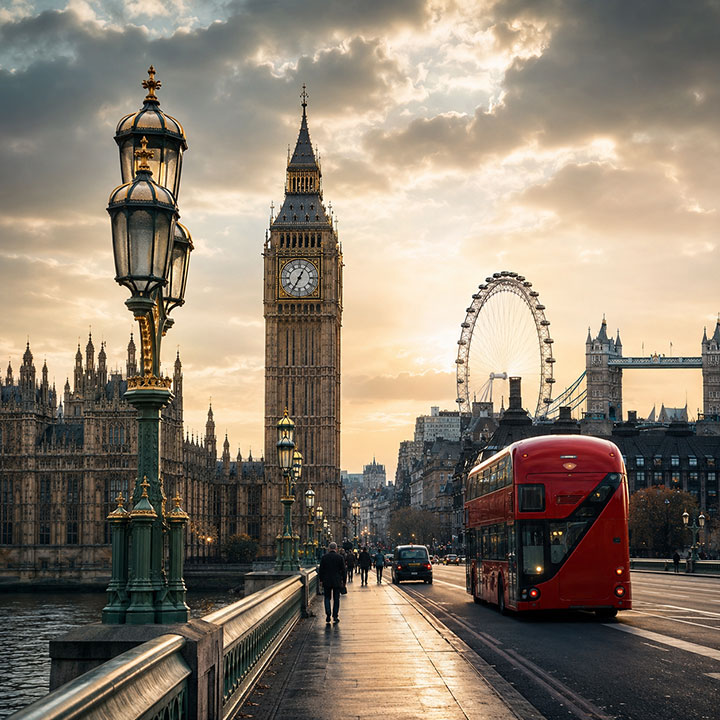
- The Palace of Westminster: Rebuilt in the magnificent Gothic Revival style following a fire in 1834, it stands as the ultimate symbol of Victorian parliamentary power and national identity. This palace is located in Westminster.
- The Victoria and Albert Museum: Founded after the Great Exhibition of 1851, this museum was designed to showcase the best of art, design, and Victorian manufacturing prowess. This museum is located in South Kensington.
- The Natural History Museum: A “Cathedral of Nature” built to house the vast collections of the Victorian age, including the revolutionary discoveries that shaped the modern understanding of the natural world. This museum is located in South Kensington.
- Tower Bridge: A masterpiece of Victorian engineering that combined a massive steel frame with ornate stone cladding to manage the intense river traffic of the world’s busiest port. This bridge is located between the City of London and Southwark.
- The Royal Albert Hall: Built as a memorial to Prince Albert, this “Village Hall of the Empire” remains one of the world’s most famous stages for music and national celebration. This hall is located in South Kensington.
- St Pancras International and King’s Cross: These great railway cathedrals represent the Victorian mastery of movement and the engineering genius that connected the capital to the industrial north. These stations are located in Camden, London.
Windsors
The House of Windsor has guided the United Kingdom through a century of unprecedented global change, from the height of the British Empire to the modern Commonwealth era. This dynasty has seen the monarchy evolve into a symbol of national continuity and service, navigating two World Wars and the transition into a digital age. The Windsors have maintained the “theatre of power” while modernizing the Crown’s relationship with the public, ensuring that ancient rituals like the Coronation remain relevant in a contemporary democracy. This period is defined by a sense of quiet duty and a relentless focus on national unity, bridging the gap between a thousand years of tradition and the challenges of the 21st century.
- Westminster Abbey: The setting for the coronation of every Windsor monarch, from George V to King Charles III, and the site of significant royal weddings and funerals that have captured the global imagination. This abbey is located in Westminster.
- Buckingham Palace: The official London residence of the Sovereign since 1837 and the administrative headquarters of the Monarchy, serving as the focal point for national celebrations and royal appearances on the iconic balcony. This palace is located in Westminster.
- The Tower of London: While serving as a historic fortress, it continues to house the Crown Jewels, the most powerful physical symbols of the Windsor monarchy used during the Coronation rite. This fortress is located in the City of London.
- St Paul’s Cathedral: The site of the 1981 Royal Wedding of Prince Charles and Lady Diana Spencer, and the setting for national thanksgivings such as the Diamond and Platinum Jubilees of Queen Elizabeth II. This cathedral is located in the City of London.
- Windsor Castle: The oldest and largest occupied castle in the world, serving as a private royal home, a setting for state visits, and the final resting place of many Windsor monarchs in St George’s Chapel. This castle is located in Windsor, Berkshire.
- The Mall: The grand ceremonial approach to Buckingham Palace, designed as a triumphal route for royal processions and state occasions that define the visual identity of the Windsor era. This road is located in Westminster.