
London Districts, Streets and Urban Character
London is not a single city but a sprawling tapestry of villages, each with its own heartbeat, history, and unspoken rules. To walk its streets is to move through time as much as space: one moment you are amid the medieval alleys of the City of London, the next you are crossing the river to the radical, creative energy of the South Bank. The character of London lies in these contrasts: the formal garden squares of Bloomsbury versus the neon intensity of Soho, the maritime quiet of Greenwich versus the vertical ambition of Docklands. Understanding the capital means abandoning the idea of a single “centre” and instead learning to read the subtle shifts in architecture, accent, and attitude that define one district from the next.
Westminster
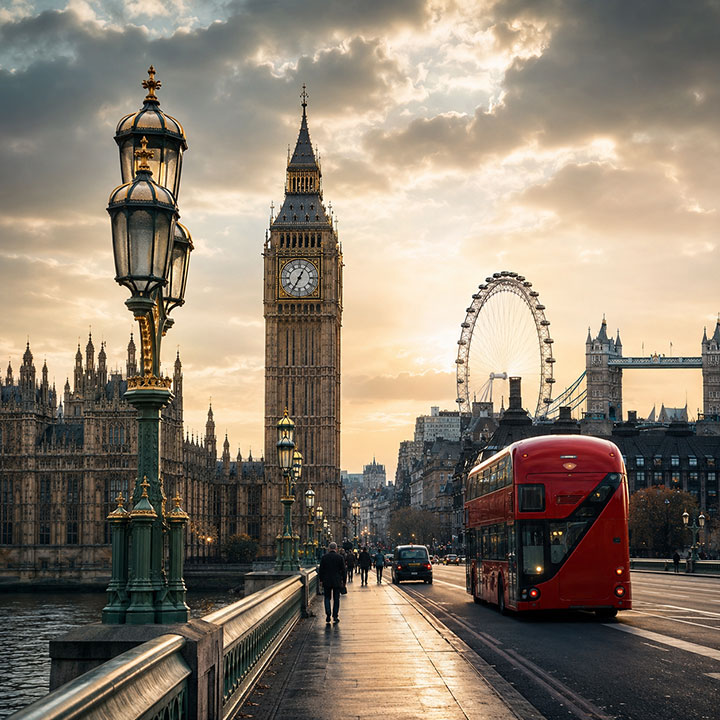
Westminster is the political and royal heart of the United Kingdom, serving as the setting where the nation’s governance and monarchy have been entwined for nearly a millennium. Dominated by the “Mother of Parliaments” and the site of every coronation since 1066, this district represents the formal projection of British state power and tradition. To walk through Westminster is to experience the “Architecture of Authority,” revealing how the concentration of executive, legislative, and religious institutions in one square mile has shaped the global standards for democracy and constitutional monarchy.

- The Houses of Parliament: The iconic seat of the UK government, representing the Westminster model of democracy that has been exported to nations worldwide. This building is located in Westminster.
- Westminster Abbey: The historic setting for coronations, royal weddings, and the final resting place of monarchs and scientists like Sir Isaac Newton and Charles Darwin. This abbey is located in Westminster.
- Buckingham Palace: The official London residence of the British monarch since 1837 and the focus of national celebrations. This palace is located in Westminster.
- Downing Street: The modest but world-famous street housing the official residence and office of the Prime Minister at Number 10. This street is located in Westminster.
- Whitehall: The ceremonial thoroughfare lined with major government departments and the Cenotaph, acting as the administrative center of the British state. This street is located in Westminster.
- St James’s Park: The oldest of the Royal Parks, once a private hunting ground for Henry VIII and now a public space surrounded by three royal palaces. This park is located in Westminster.




City of London
The City of London, often referred to as the “Square Mile,” is the historic core of the capital and a global titan of international finance. Established by the Romans as Londinium, it maintains its own distinct police force and ancient traditions while serving as a ultra-modern hub for global trade and commerce. The City represents a unique synthesis of the “Ancient and the Avant-Garde,” where medieval alleyways sit in the shadow of glass skyscrapers. Understanding the City is essential to decoding London’s identity as a resilient commercial powerhouse that has rebuilt itself through fire and war to remain at the center of the world’s financial markets.
- St Paul’s Cathedral: Christopher Wren’s baroque masterpiece and a soaring symbol of the City’s resilience, standing at its highest point. This cathedral is located in the City of London.
- The Tower of London: A 1,000-year-old fortress, palace, and former prison that protects the Crown Jewels and reflects the City’s medieval origins. This castle is located in the City of London.
- The Royal Exchange: The historic heart of British commerce, founded in the 16th century to act as a center for the City’s merchants. This building is located in the City of London.
- The Guildhall: The administrative and ceremonial center of the City of London Corporation, which has governed the Square Mile for centuries. This building is located in the City of London.
- The Monument: A Doric column designed by Christopher Wren to commemorate the Great Fire of 1614 and celebrate the City’s subsequent rebirth. This monument is located in the City of London.
- Bevis Marks Synagogue: The oldest synagogue in the United Kingdom, reflecting the long-standing history of the Jewish community within the City. This synagogue is located in the City of London.
Greenwich
Greenwich is the global epicenter of time and navigation, serving as the site where Britain’s maritime power was formally synthesized with astronomical science. Established by the monarchy to solve the “Problem of Longitude,” it became the home of the Prime Meridian, the invisible line that divides the Eastern and Western Hemispheres and synchronizes the world’s clocks. Greenwich represents the peak of British intellectual and naval synergy, projecting an image of scientific authority that defined the era of global exploration. Understanding Greenwich is essential to decoding how London became the “Timekeeper to the World,” providing the navigation tools that made international trade and modern travel possible.
- The Royal Observatory: The historic home of British astronomy and the site of the Prime Meridian (Longitude 0°), where the quest for precision timekeeping was won. This site is located in Greenwich Park.
- The Queen’s House: A masterpiece of classical architecture designed by Inigo Jones; it was the first classically designed building in England. This house is located in Greenwich.
- The National Maritime Museum: The world’s largest maritime museum, housing the instruments, charts, and artifacts that supported Britain’s scientific and naval dominance. This museum is located in Greenwich.
- The Old Royal Naval College: A masterpiece of baroque architecture by Christopher Wren that served as a primary filming location for productions like The Crown and Les Misérables. This site is located in Greenwich.
- The Cutty Sark: The world’s sole surviving tea clipper, representing the peak of 19th-century merchant shipping technology and the acceleration of global trade. This ship is located in Greenwich.
Docklands
The Docklands represents the industrial lungs of Victorian London, once comprising the largest docks complex in the world and serving as the primary gateway for the British Empire’s global trade. This district’s narrative is one of “Transformation and Regeneration,” moving from a landscape of high-walled quayside warehouses to a high-tech financial second city at Canary Wharf. To study the Docklands is to witness the physical scale of the Industrial Revolution, revealing how the shift from river-based to inland docks changed the pace of international commerce. Today, the area serves as a visceral reminder of London’s maritime past, where the history of sugar, slavery, and global exchange is being actively commemorated and reinterpreted.
- Museum of London Docklands: Housed in a historic 19th-century warehouse, it features the “London, Sugar and Slavery” exhibition documenting the city’s role in the transatlantic trade. This museum is located at West India Quay.
- St Katharine Docks: A historic dock designed by Thomas Telford and Philip Hardwick, now a residential and leisure complex near the Tower of London. This dock is located in the London Borough of Tower Hamlets.
- Canary Wharf: The modern heart of the Docklands, representing the area’s massive late-20th-century regeneration into a global financial hub. This district is located in the Isle of Dogs.
- West India Quay: The site of a new memorial to victims of the transatlantic slave trade, designed in the shape of a cowry shell. This quay is located in the Docklands.
- The Thames Path: A riverside route providing access to the changing landscape of the Docklands, from historic maritime sites to contemporary skyscrapers. This path runs along the river through Wapping and Limehouse.
Soho
Soho is the vibrant and layered heart of London’s cultural identity, serving as a historic laboratory for music, theatre, and creative rebellion. Once an aristocratic hunting ground, it evolved into a cosmopolitan district where diverse migration and nightlife created a unique “Bohemian” atmosphere. Soho represents the intersection of the mainstream and the alternative, housing both the historic “Theatreland” and the legendary venues that birthed British rock and pop. To explore Soho is to study the “Pulse of the City,” revealing how a single neighborhood can simultaneously represent the pinnacle of high culture and the radical edge of modern British identity.
- Carnaby Street: The epicenter of the “Swinging Sixties” fashion revolution and a global symbol of the fusion between music and style. This street is located in Soho.
- Ronnie Scott’s Jazz Club: A legendary venue that has served as a cornerstone of Soho’s music heritage for decades. This club is located in Soho.
- Trident Studios: A historic recording studio where musical icons like David Bowie and The Beatles recorded some of their most influential works. This studio is located in Soho.
- Denmark Street: Known as London’s “Tin Pan Alley,” it is the historic heart of the British music publishing and instrument industry. This street is located in Soho.
- The West End Theatres: The global center for musical theatre and drama, reflecting the district’s enduring role as a primary site for performance. These theatres are located across Soho and the City of Westminster.
Marylebone / Fitzrovia
Marylebone and Fitzrovia represent the refined, intellectual, and medical layers of London’s urban character, serving as a tranquil counterpoint to the nearby bustle of the West End. From the “Harley Street” medical excellence to the artistic “Bohemia” of Fitzrovia’s historic pubs, these districts project an image of Georgian elegance and professional achievement. To walk these streets is to explore the “Mind of London,” revealing how the city’s drive for both scientific precision and creative expression found a home in these meticulously planned urban grids.
- The Royal Academy of Music: Founded in 1822, it is the UK’s oldest conservatoire and a world leader in musical training. This academy is located in Marylebone Road.
- The Wallace Collection: A world-class museum of art and armour housed in the historic Hertford House, representing the peak of private aristocratic collecting. This collection is located in Manchester Square.
- Wigmore Hall: One of the world’s great concert halls, renowned for its intimate acoustics and focus on chamber music and song. This hall is located in Wigmore Street.
- The BT Tower: A futuristic icon of the 1960s that served as a communications hub and remains a soaring landmark of the Fitzrovia skyline. This tower is located in Fitzrovia.
- Harley Street: Globally synonymous with private medical excellence and the site of pioneering clinical practice for over two centuries. This street is located in Marylebone.
Mayfair and St James’s
Mayfair and St James’s are the twin pillars of London’s high-status identity, serving as the definitive settings for aristocratic luxury, private members’ clubs, and global diplomacy. Developed in the 17th and 18th centuries, these districts represent the “Elite Standard of London,” where the architecture of power is expressed through grand townhouses and exclusive commercial arcades. Understanding Mayfair and St James’s is essential to decoding the enduring influence of the British establishment and the city’s role as a playground for the world’s most influential figures.
- Savile Row: The global home of bespoke tailoring, where the “Rebels and Royals” of history have been outfitted for generations. This street is located in Mayfair.
- St James’s Palace: A senior royal palace and the formal location of the Royal Court, reflecting the district’s deep ties to the monarchy. This palace is located in St James’s.
- The Royal Academy of Arts: An independent, artist-led institution that has championed British art and architecture since 1768. This academy is located in Burlington House, Piccadilly.
- Claridge’s Hotel: Known as the “annex of the palace,” it has hosted royalty and music legends like Freddie Mercury and Elton John. This hotel is located in Brook Street, Mayfair.
- Fortnum & Mason: The world’s most famous grocer and a primary supplier to the royal household for over 300 years. This store is located in Piccadilly.
South Bank
The South Bank is the vibrant “Cultural Corridor” of modern London, serving as the site where postwar planning transformed an industrial landscape into a world-class center for the arts. Dominated by the brutalist architecture of the Southbank Centre and the National Theatre, this district represents Britain’s 20th-century democratic vision for accessible culture and public space. To visit the South Bank is to witness the “Rebirth of the Riverside,” revealing how London bridged its historic past with a dynamic, inclusive, and highly creative future.
- The Royal Festival Hall: Built for the 1951 Festival of Britain, it serves as the cornerstone of the Southbank Centre’s musical and cultural programming. This hall is located on the South Bank.
- The National Theatre: A masterpiece of modernist architecture that houses three separate theatres and champions the best of British and international drama. This theatre is located on the South Bank.
- The London Eye: A modern landmark of engineering that provides a panoramic “Flight over London,” symbolizing the city’s constant evolution. This attraction is located on the South Bank.
- Shakespeare’s Globe: A faithful reconstruction of the original 1599 playhouse, celebrating the enduring legacy of the world’s greatest playwright. This theatre is located in Southwark.
- The Hayward Gallery: A world-renowned site for contemporary art, known for its distinctive concrete architecture and daring exhibition programme. This gallery is located on the South Bank.
Bloomsbury
Bloomsbury is the intellectual and literary heart of London, serving as a historic hub for publishers, scholars, and the avant-garde. Home to the British Museum and the various colleges of the University of London, the district represents the peak of the “Academic and Enlightenment” era, where knowledge was formally categorized and debated. To study Bloomsbury is to walk through the “Mind of the Nation,” revealing how the concentration of museums and libraries fostered a unique environment of inquiry that shaped global thought.
- The British Museum: Established in 1753 to house the vast collections of Sir Hans Sloane, reflecting the era’s obsessive drive to understand the world. This museum is located in Bloomsbury.
- The British Library: The national library of the UK, preserving intellectual treasures like the Magna Carta and original Beatles lyrics. This library is located in Euston Road.
- The University of London (Senate House): The administrative heart of the university system, whose art deco architecture famously inspired George Orwell’s “Ministry of Truth.” This building is located in Bloomsbury.
- The Dickens House Museum: The former residence of Charles Dickens where he wrote Oliver Twist, capturing the district’s deep literary roots. This museum is located in Doughty Street.
- The Foundling Museum: A site exploring the history of the UK’s first children’s charity, reflecting Bloomsbury’s historic role in social reform and philanthropy. This museum is located in Brunswick Square.
Kensington
Kensington is the “Royal and Scientific” enclave of London, defined by its grand architecture, expansive parks, and the cultural legacy of Prince Albert’s vision for “Albertopolis.” This district represents the 19th-century ideal of integrating the arts, sciences, and education into a single, accessible urban landscape. To explore Kensington is to witness the “Golden Age of Victorian Progress,” revealing how royal patronage turned a quiet suburb into a world-class center for research and high-status living.
- The Natural History Museum: Known as a “Cathedral of Nature,” it serves as a global center for biodiversity research. This museum is located in South Kensington.
- The Science Museum: The definitive home of British ingenuity, housing the iconic artifacts of the industrial and information ages. This museum is located in South Kensington.
- The Victoria and Albert Museum (V&A): The world’s leading museum of art and design, celebrating human creativity across 5,000 years. This museum is located in South Kensington.
- The Royal Albert Hall: A world-famous concert venue and a primary monument to Prince Albert’s cultural legacy. This hall is located in Kensington Gore.
- Kensington Palace: A historic royal residence that has been home to young royals for over 300 years. This palace is located in Kensington Gardens.
- Holland Park: One of London’s most romantic and peaceful parks, featuring the beautiful Kyoto Japanese Garden. This park is located in Kensington.
Film, Literature and Location-Based London
Film, Literature, and Location-Based London represents the city’s role as the world’s most versatile “Living Set,” where real streets and buildings provide the narrative backbone for global storytelling. From the fog-bound alleys of Sherlock Holmes to the cinematic magic of Harry Potter’s King’s Cross, the city’s physical character is inseparable from its fictional identity. This chapter analyzes the “London of the Imagination,” showing how the city’s architecture serves as a dynamic backdrop that continuously redefines how audiences around the world perceive British culture.
- King’s Cross Station (Platform 9 ¾): A global pilgrimage site for Harry Potter fans, representing the intersection of Victorian infrastructure and modern fantasy. This station is located in Euston Road.
- The Sherlock Holmes Museum: Located at the fictional detective’s world-famous address, celebrating the enduring legacy of Sir Arthur Conan Doyle’s creations. This museum is located in 221B Baker Street.
- Globe Theatre: A reconstruction of the playhouse where Shakespeare’s works first came to life, acting as the spiritual home of English literature. This theatre is located in Southwark.
- Notting Hill: The vibrant district synonymous with the 1999 romantic comedy, highlighting London’s role in modern cinematic branding. This district is located in the Royal Borough of Kensington and Chelsea.
- The Old Royal Naval College: A premier filming location used in The Crown, The King’s Speech, and Skyfall for its grand baroque scale. This site is located in Greenwich.