
Science, Ideas and Innovation
The “Science, Ideas and Innovation” branch of the curriculum reveals Britain’s role as the engine room of global discovery. From the mathematical laws of the universe to the biological origins of life, British thinkers have consistently moved humanity from the realm of mystery to measurable truth.
Scientific revolution
The Scientific Revolution in Britain represents the transformative era when the nation became the world’s primary laboratory for empirical discovery and reason. Moving away from medieval superstition, figures such as Sir Isaac Newton and Robert Boyle established the foundational laws of physics and chemistry that still govern our understanding of the universe. This period saw the birth of the Royal Society, the world’s oldest independent scientific academy, fostering a culture of rigorous experimentation and international collaboration. To study this branch is to witness the “Age of Enlightenment” in action, revealing how British innovation moved humanity from a world of mystery to one of measurable, scientific truth.

- The Royal Society: The spiritual home of British science since 1660, serving as the setting where the greatest minds of the revolution debated their groundbreaking theories. This society is located in Carlton House Terrace, Westminster.
- The Royal Observatory: Founded by Charles II in 1675, it was the site of the primary quest to solve the problem of longitude and establish the Prime Meridian. This site is located in Greenwich.
- Trinity College: The academic home of Sir Isaac Newton, where he conducted the revolutionary experiments in optics and mathematics that defined the modern scientific age. This college is located in Cambridge.
- St Paul’s Cathedral: A masterpiece of baroque architecture that also served as a site for early scientific observation, including Christopher Wren’s own astronomical studies. This cathedral is located in the City of London.
- The British Museum: Established to house the vast collections of Sir Hans Sloane, reflecting the era’s obsessive drive to categorize and understand the natural and human world. This museum is located in Bloomsbury, London.




Royal Society
The Royal Society is the oldest national scientific institution in the world and has been the engine room of global scientific progress for over 350 years. Founded during the Restoration of the monarchy, it adopted the motto “Nullius in verba”—take nobody’s word for it—signaling a total commitment to experimental proof. The Society has supported the work of giants from Charles Darwin and Michael Faraday to Albert Einstein and Stephen Hawking, acting as a permanent anchor for British intellectual achievement. Understanding the Royal Society is essential to decoding how the UK became a global leader in technology, medicine, and discovery, projecting an image of academic excellence that remains unrivaled today.
- Carlton House Terrace: The magnificent neoclassical headquarters of the Royal Society, serving as a hub for international scientific diplomacy and public engagement. This building is located in Westminster.
- The National Portrait Gallery: Home to the portraits of the Society’s most famous Fellows and Presidents, capturing the “Faces of Genius” that have shaped human history. This gallery is located in St Martin’s Place, London.
- Somerset House: The historic home of the Royal Society during the 18th and 19th centuries, where it was collocated with the Royal Academy of Arts to represent the peak of national culture. This building is located in the Strand, London.
- Gresham College: The site of the Society’s original meetings in the mid-17th century, where the founders first gathered to promote the “New Philosophy” of experimental science. This college is located in the City of London.
- The Science Museum: A premier repository housing the historic instruments, manuscripts, and discoveries that were fostered and celebrated by the Royal Society across centuries. This museum is located in South Kensington.
Darwin
Charles Darwin is the primary architect of the modern understanding of life on Earth, whose theory of evolution by natural selection fundamentally challenged the social and religious foundations of the Victorian world. His work, most famously On the Origin of Species, moved biology from the realm of classification to a dynamic narrative of adaptation and survival. Darwin’s legacy transformed London’s South Kensington into a global center for biodiversity research and established a new, evidence-based view of the human place in nature. To study Darwin is to explore the “Greatest Idea in Science,” revealing how a dedicated observer turned a voyage on the HMS Beagle into a revolution that continues to define modern genetics and conservation.
- The Natural History Museum: Known as a “Cathedral of Nature,” it houses the Darwin Centre and the vast collections that formed the evidentiary base for the theory of evolution. This museum is located in South Kensington.
- Down House: The private family home and garden where Darwin lived and worked for 40 years, conducting the meticulous experiments that underpinned his landmark publications. This house is located in Downe, Kent.
- Westminster Abbey: The final resting place of Charles Darwin, where he is buried near Sir Isaac Newton in a powerful national statement of the intersection between science and state honor. This abbey is located in Westminster.
- National Portrait Gallery: Home to the most iconic portraits of Darwin, capturing the image of the “Elder Statesman of Science” whose ideas reshaped the world’s intellectual landscape. This gallery is located in St Martin’s Place, London.
- The Linnean Society: The historic venue where Darwin and Alfred Russel Wallace first presented their joint papers on the theory of natural selection in 1858. This society is located in Burlington House, Piccadilly.
- The Royal Society: The elite academy that awarded Darwin its highest honors, recognizing his profound contribution to the advancement of natural knowledge. This society is located in Carlton House Terrace, Westminster.
Newton
Sir Isaac Newton is the primary figure of the Scientific Revolution whose work in the 17th century laid the foundations for modern physics and mathematics. His discovery of the universal law of gravitation and his groundbreaking work in optics—using prisms to prove that white light is composed of a spectrum of colors—fundamentally changed how we perceive the natural world. Newton’s legacy represents the peak of empirical reason, turning the abstract mysteries of the heavens into predictable, scientific constants. This study reveals the man who “unlocked the universe,” establishing a legacy of intellectual rigor that defines the British scientific tradition.
- Trinity College: The academic and spiritual home where Newton spent over 30 years, conducting his revolutionary experiments in light and mathematics. This college is located in Cambridge.
- Westminster Abbey: The site of Newton’s elaborate tomb, located in Scientists’ Corner, where he was the first scientist to be buried with the full honors of the state. This abbey is located in Westminster.
- The Royal Society: The institution where Newton served as President for 24 years, overseeing the formalization of the scientific method in Britain. This society is located in Carlton House Terrace, Westminster.
- The Royal Observatory: An institution Newton supported and utilized to refine his astronomical theories through the observation of planetary motions. This site is located in Greenwich.
- Woolsthorpe Manor: Newton’s birthplace and the site of the “Year of Wonders” (1665) where he observed the famous falling apple and began his work on calculus. This manor is located in Grantham, Lincolnshire.
Faraday
Michael Faraday was the self-taught visionary who bridged the gap between theoretical science and the practical, electrified world of the modern age. Rising from a humble background as a bookbinder’s apprentice, he became the director of the Royal Institution, where his experiments with electromagnetism led to the invention of the electric motor and the dynamo. Faraday’s work effectively “captured lightning,” transforming electricity from a laboratory curiosity into a universal power source that drives modern industry and communication. To study Faraday is to explore the “Spirit of Experimentation,” revealing how British ingenuity democratized power and paved the way for the electronic era.
- The Royal Institution: The site of Faraday’s basement laboratory where he spent decades conducting the lectures and experiments that revolutionized our understanding of energy. This institution is located in Albemarle Street, Mayfair.
- The Science Museum: A premier repository that houses Faraday’s original experimental apparatus, including early induction coils and magnets. This museum is located in South Kensington.
- The Faraday Museum: A dedicated space within the Royal Institution that preserves his 1850s laboratory in its original state. This museum is located in Albemarle Street, Mayfair.
- Savoy Place: Home to a prominent statue of Faraday outside the Institution of Engineering and Technology, marking his role as the “father of electrical engineering.” This site is located in the Strand, London.
- Highgate Cemetery: The final resting place of Michael Faraday, reflecting his modest character through a simple headstone in the dissenters’ section. This cemetery is located in Highgate, London.
Industrial innovation
Industrial Innovation in Britain represents the era when scientific theory was forged into mechanical power, triggering the first Industrial Revolution. Driven by figures like James Watt, George Stephenson, and Isambard Kingdom Brunel, Britain became the “Workshop of the World,” pioneering steam power, the railway, and large-scale civil engineering. This movement transformed Britain from an agrarian society into an urban, global powerhouse, redefining the relationship between human labor and technology. Studying this chapter provides the “Blueprint of Modernity,” showing how British engineers built the infrastructure—from bridges to steamships—that accelerated the pace of global trade and travel forever.
- The Science Museum: The definitive collection of industrial icons, featuring James Watt’s workshop and the “Rocket” steam locomotive. This museum is located in South Kensington.
- Iron Bridge: The world’s first cast-iron bridge, built in 1779, serving as a soaring symbol of the dawn of the industrial age. This bridge is located in Ironbridge, Shropshire.
- The SS Great Britain: Brunel’s masterpiece and the world’s first great ocean liner, representing the peak of 19th-century maritime engineering. This ship is located in Bristol.
- The London Museum Docklands: A site exploring how industrial innovation fueled London’s growth as a global trade hub through the construction of its massive dock systems. This museum is located in West India Quay, London.
- Paddington Station: A functional masterpiece of Victorian engineering designed by Brunel to serve as the gateway for his Great Western Railway. This station is located in Paddington, London.
Medicine and public health
The British contribution to medicine and public health represents the nation’s enduring commitment to clinical observation and the eradication of global disease. From the discovery of the circulatory system to the creation of the first vaccine, British practitioners moved medical science from medieval theory to a modern, evidence-based discipline. This period saw the birth of the National Health Service (NHS), projecting a vision of healthcare as a fundamental human right that remains a cornerstone of national identity. To study this branch is to witness the “Anatomy of Progress,” revealing how British medical pioneers transformed the quality and duration of human life across the globe.
- The Old Operating Theatre Museum: The oldest surviving surgical theatre in Europe, providing a visceral look at pre-anaesthetic surgery and early apothecary traditions. This museum is located in St Thomas’ Church, Southwark.
- The Alexander Fleming Laboratory Museum: The site where Fleming discovered penicillin in 1928, marking the dawn of the antibiotic age and the most significant breakthrough in modern medical history. This museum is located in St Mary’s Hospital, Paddington.
- The Florence Nightingale Museum: A site celebrating the “Founder of Modern Nursing,” whose work during the Crimean War established the standards for sanitation and professional healthcare. This museum is located in Lambeth Palace Road.
- The Royal College of Physicians: The historic body that has regulated medical practice in Britain since 1518, housing a vast collection of anatomical and clinical heritage. This college is located in Regent’s Park.
- The Wellcome Collection: A museum and library exploring the connections between medicine, life, and art, reflecting the modern drive to understand the human condition. This collection is located in Euston Road.
Greenwich and astronomy / navigation
Greenwich is the global epicenter of time and navigation, serving as the site where Britain’s maritime power was formally synthesized with astronomical science. Established by the monarchy to solve the “Problem of Longitude,” it became the home of the Prime Meridian, the invisible line that divides the Eastern and Western Hemispheres and synchronizes the world’s clocks. Greenwich represents the peak of British intellectual and naval synergy, projecting an image of scientific authority that defined the era of global exploration. Understanding Greenwich is essential to decoding how London became the “Timekeeper to the World,” providing the navigation tools that made international trade and modern travel possible.
- The Royal Observatory: The historic home of British astronomy and the site of the Prime Meridian (Longitude 0°), where the quest for precision timekeeping was won. This site is located in Greenwich.
- The Queen’s House: A masterpiece of classical architecture that served as a royal residence and a center for courtly artistic patronage during the scientific age. This house is located in Greenwich.
- The National Maritime Museum: The world’s largest maritime museum, housing the instruments, charts, and artifacts that supported Britain’s scientific and naval dominance. This museum is located in Greenwich.
- The Old Royal Naval College: Christopher Wren’s baroque masterpiece, serving as a grand hospital for seamen and a testament to the nation’s maritime heritage. This college is located in Greenwich.
- The Cutty Sark: The world’s sole surviving tea clipper, representing the peak of 19th-century merchant shipping technology and the acceleration of global trade. This ship is located in Greenwich.
The Natural History Museum
The Natural History Museum is a “Cathedral of Nature,” established to house the vast biological and geological collections that fueled Britain’s era of scientific discovery. Originally part of the British Museum, it was moved to its own purpose-built site in South Kensington to reflect the growing importance of the natural sciences in the Victorian age. The museum serves as a global center for biodiversity research, containing over 80 million specimens that document the history of life on Earth. To visit this museum is to explore the “Physical Record of Evolution,” revealing how British scientists moved from mere collection to a profound, evidence-based understanding of the natural world.
- The Hintze Hall: The grand entrance hall dominated by “Hope,” the blue whale skeleton, representing the museum’s commitment to the future of the natural world. This hall is located in South Kensington.
- The Darwin Centre: A state-of-the-art facility housing millions of preserved specimens and providing a window into the ongoing work of modern taxonomists. This centre is located in South Kensington.
- The Earth Galleries: A series of exhibitions exploring the geological forces that shaped our planet, featuring the famous “Earthquake Simulator.” These galleries are located in South Kensington.
- The Anning Rooms: Dedicated to Mary Anning, the pioneering palaeontologist whose fossil discoveries in the 19th century challenged existing views of Earth’s history. These rooms are located in South Kensington.
- The Wildlife Garden: An outdoor laboratory that demonstrates the museum’s role in modern conservation and the study of urban biodiversity. This garden is located in South Kensington.
Science Museum
The Science Museum is the definitive home of British ingenuity, serving as a massive repository for the physical history of global innovation. Established following the Great Exhibition of 1851, it was designed to inspire the public by showcasing the rapid advancements of the industrial and scientific age. Today, it houses everything from the earliest steam engines to the modules that took humanity into space, acting as a bridge between the foundational discoveries of the past and the technological frontiers of the future. To explore the Science Museum is to walk through the “Timeline of Human Progress,” revealing how British curiosity and engineering transformed the world from a collection of isolated communities into a connected, modern civilization.
- The Energy Hall: A soaring gallery featuring the massive steam engines that powered the Industrial Revolution, including James Watt’s original workshop. This hall is located in South Kensington.
- The Exploring Space Gallery: A collection of rockets, satellites, and space probes that highlight Britain’s contributions to atmospheric and extraterrestrial research. This gallery is located in South Kensington.
- The Making the Modern World Gallery: Home to the most iconic objects in the history of technology, from the Apollo 10 command module to the first Apple computer. This gallery is located in South Kensington.
- The Medicine Galleries: A world-class display of medical artifacts that trace the evolution of healthcare and the human body’s secrets. These galleries are located in South Kensington.
- The Information Age Gallery: An exhibition exploring how communication and information technology have reshaped human life over the last 200 years. This gallery is located in South Kensington.
Britain’s role in shaping the modern world
Britain’s role in shaping the modern world represents the global projection of British ideas, laws, and technologies that created the framework of contemporary international life. From the invention of the World Wide Web by Tim Berners-Lee to the global adoption of the English language and parliamentary democracy, British influence has acted as a “Global Operating System.” This chapter examines how a small island nation exported the concepts of free trade, human rights, and scientific inquiry to every corner of the map. To study this legacy is to analyze the “Architectural Plan of the Modern Era,” revealing how British innovations in governance and technology continue to underpin the structures of the 21st century.
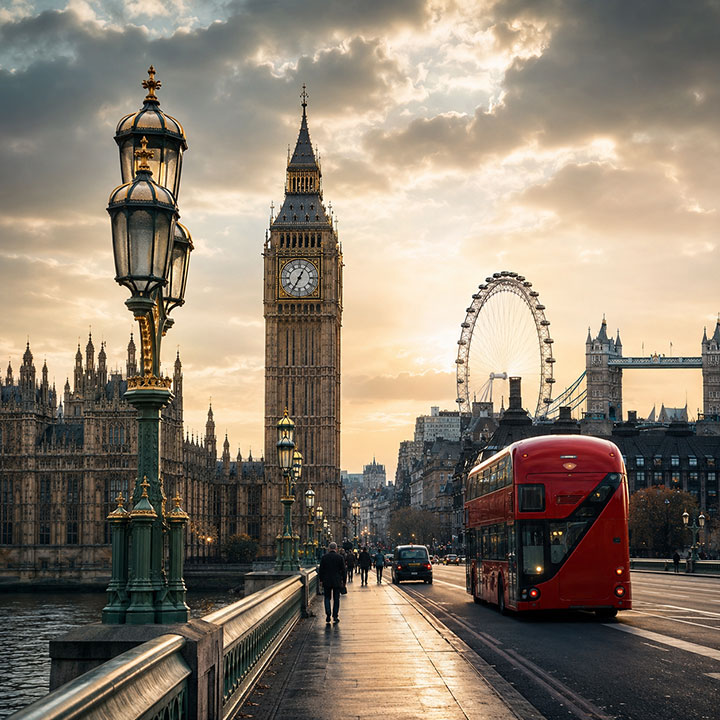
- The Houses of Parliament: The “Mother of Parliaments,” representing the export of the Westminster model of democracy to nations around the globe. This building is located in Westminster.
- The British Library: The national library of the UK and one of the largest in the world, preserving the intellectual output that has shaped global thought. This library is located in Euston Road.
- The Royal Exchange: The historic heart of British commerce, symbolizing the nation’s role in establishing the modern global financial system. This building is located in the City of London.
- The BBC Broadcasting House: The headquarters of the world’s oldest national broadcaster, projecting British culture and values to a global audience. This building is located in Portland Place, London.
- The CERN Office (UK Mission): Representing Britain’s ongoing leadership in international scientific collaboration, such as the birth of the World Wide Web. This mission is located in Geneva (with its administrative hub in London).